

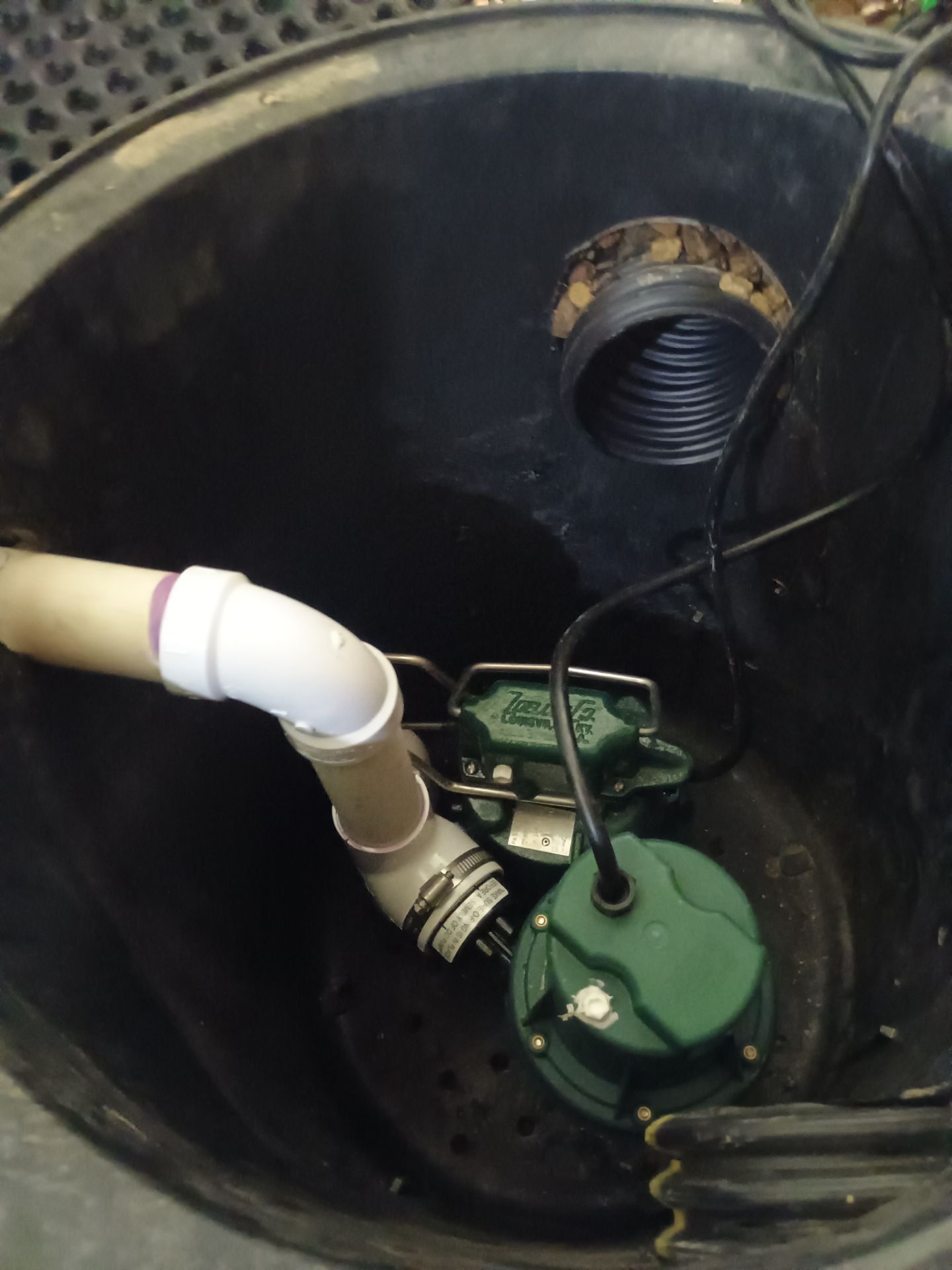
The pump is the only mechanical link between you and a flooded basement.
A drain tile system is passive plumbing. It collects water by gravity into a sump basin. The water has no way out of the basin without mechanical assistance, that's the sump pump's job. Switch on, lift the water up through the discharge pipe, push it out beyond the foundation, switch off. Repeat thousands of times during a wet spring.
When the drainage system terminates at a sump, pump failure removes its mechanical outlet. That is why pump selection, discharge design, alarms, maintenance, and backup capacity deserve the same attention as the drainage system itself.
Cast iron housing. PSC motor. Vortex impeller.
The difference between a $90 box-store pump and a properly engineered residential sump pump comes down to three components:
Cast iron housing
Submersible pumps run hot. The motor sits in a sealed oil bath, and that bath must dissipate heat into the surrounding water. Cast iron has roughly three times the thermal conductivity of plastic. During a heavy spring runoff, when the pump may run for 30 to 60 seconds, rest, and re-fire continuously for days, a cast iron housing pulls heat into the sump water and stays within thermal tolerance. A plastic housing traps that heat. The motor cooks. The pump dies. Almost always during the worst weather event of the year.
Permanent split capacitor (PSC) motor
The motor type on the spec sheet is doing more work than the horsepower number. PSC motors use a permanent capacitor in the run circuit, delivering high starting torque, smoother run characteristics, and lower energy consumption than the cheaper shaded-pole or split-phase alternatives. Less heat, less wear, fewer current spikes, longer service life. A published pump curve, serviceable parts, and a known manufacturer make performance and replacement planning easier to evaluate than an unknown private-label unit.
Vortex impeller and stainless hardware
Sumps in older Minnesota basements collect more than just water, iron-ochre bacteria, silt, occasional debris from old drain tile. A vortex impellerdesign moves water without requiring it to contact the impeller blades directly, allowing solids to pass through without binding the pump. Stainless steel hardware on the float switch and fasteners means the pump doesn't rust shut during the years it sits between flood events.
Battery backup is an optional layer of protection.
The backup WPNE offers is the Zoeller Aquanot Spin 508, paired with an approved AGM battery. It is an independent 12V DC pump with its own float switch and controller. Before quoting it, WPNE confirms that the basin, primary pump, power, and discharge configuration can support the selected setup.
Why maintenance-free AGM
- Sealed, no electrolyte to check or top off, flooded lead-acid batteries lose water over time and need periodic distilled-water top-ups. Most homeowners don't do it. AGM removes that failure mode.
- Tolerates basement temperature swings, AGM holds capacity better than flooded lead-acid in the cold corner of an unfinished basement.
- Deep-cycle service life, sized to handle dozens to hundreds of pump cycles per outage event without thermal stress.
- Runtime is load-dependent, changing with battery condition, water inflow, cycling, head height, and system configuration. WPNE does not promise a fixed outage runtime.
For a basement housing finished space, mechanicals, or valuable contents, redundancy is worth discussing. The Spin 508 and approved AGM battery remain an optional, separately priced choice.
Horsepower, flow rate, and head height.
Sump pumps aren't graded by horsepower alone. The three numbers that matter:
- Horsepower (HP): Common residential sizes are 1/3 HP, 1/2 HP, and 3/4 HP. Higher HP = more lift capacity and faster recovery between cycles, but also more current draw and more heat generation. For most Twin Cities residential basements, 1/3 HP is the right size, it handles real-world spring flow without overheating between cycles.
- Flow rate (GPM at vertical head): Measured at a specific lift height. A Zoeller M53 1/3 HP delivers about 43 GPM at 5 ft of head. For heavier flow situations, very high water tables, lake-side lots, or larger catchment areas, we move to a Zoeller M98 1/2 HP, which delivers about 80 GPM at 0 ft of head and roughly 43 GPM at 10 ft of head.
- Head height: Vertical distance from the water surface in the basin to the discharge point outside the foundation. Most Twin Cities basements have 8 to 12 feet of head when you add basin depth, slab height, and discharge run.
A pump rated “80 GPM” on the box may only deliver 35 GPM in your basement. We size for real-world lift, not spec-sheet maximum.
Why some “exclusive in-house pumps” are white-labeled.
Ask who manufactures the pump. If the honest answer isn't a name you can look up, you're paying franchise markup for unknown engineering.
If a sales rep tells you they install “our exclusive proprietary pump,” ask three questions:
- Who actually manufactures it?
- Is the housing cast iron or thermoplastic?
- What's the motor type, PSC, shaded-pole, or split-phase?
The honest answer to the first question is almost never “we make it.” A handful of pump factories produce the actual hardware that gets sold under dozens of brand names. A national waterproofing franchise buys pumps in container-load quantities from one of these factories, badges them with their brand sticker, and sells them at substantial markup as “our exclusive pump.”
That's not inherently bad. The factory might be fine. But you should know:
- Replacement parts may only be available through that one company. If they go out of business or change suppliers, your pump becomes orphan hardware. Replacement requires a full pump swap.
- Independent service is harder. A plumber or another waterproofing company may refuse to service a brand they don't recognize because they can't source parts.
- The pump may not be the spec it's sold as. Plastic housings and shaded-pole motors get marketed as “premium” with stickers and warranties that don't reflect actual engineering quality.
We install Zoeller because Zoeller publishes their specs, sells parts through independent plumbing supply, and has built submersible pumps for sump and effluent applications since 1939. If WPNE ever stops existing, your Zoeller pump is still serviceable by any plumber in the country.
What we install.
- •Approved American-made Zoeller primary pump, with the exact model stated in the proposal
- •Tethered float switch, more reliable than vertical switches
- •1.5″ PVC discharge with check valve at the basin
- •Sealed sump lid, reduces radon, keeps humidity in the basin
- •Optional Zoeller Aquanot Spin 508 backup with an approved AGM battery when selected
- •Plastic-housing box-store pumps that fail in 3–5 years
- •Shaded-pole or split-phase motors marketed as “premium”
- •White-labeled “exclusive” pumps with no published spec sheet
- •Pumps without thermal overload protection
- •Treating backup as included when it was not selected in writing
- •Flooded lead-acid batteries that need water top-ups to stay reliable
Primary pump on a WPNE proposal:
- Approved American-made Zoeller primary pump, selected for the observed load, lift, discharge, basin, and system configuration. The exact model belongs in the proposal and final job record.
- Tethered float switch for higher reliability than vertical switches in basins with debris.
- 1.5″ PVC discharge pipe, check valve at the basin, pitched to drain outside the freeze line.
- Sealed sump basin lid with vent and access port, reduces radon, prevents humidity from venting into the basement.
Optional backup, when selected:
- Zoeller Aquanot Spin 508 battery backup, independent 12V DC pump with its own float switch and controller.
- Approved AGM battery, with actual runtime dependent on battery condition, inflow, cycling, head height, and configuration.
Pumps, batteries, and controllers carry their applicable manufacturer coverage. WPNE's installation-workmanship coverage is stated separately in the signed proposal; product failure is not a lifetime workmanship promise.
Replace the pump or service the system.
Replace if:
- Age, cycle history, or maintenance condition indicates that planned replacement is safer than waiting for failure
- It runs and runs without lowering the water level, impeller is worn or clogged
- It cycles rapidly on and off, float switch is failing
- You hear grinding, screeching, or hot-electrical smells, motor bearings or windings are failing
- The check valve has failed and water is backflowing into the basin between cycles
- The plastic housing is cracked or warped, common failure mode on box-store pumps after 3–5 years
Service the system, don't replace the pump, if:
- The pump itself sounds healthy but the basin is silting up, clean and flush
- The discharge line is partially blocked by ice or debris, clear the line
- The float switch is hung up on something in the basin, clear the basin
A failing pump is not the same as a failing system. We'll tell you which you have.