

Waterproofing starts at the roof and the grade. Not in the basement.
A 2,000-square-foot roof sheds approximately 1,250 gallons of water during a single 1-inch rain event. If your downspouts dump that volume within three feet of the foundation, or if your yard slopes toward the house instead of away from it, you are actively flooding your own basement. No interior system can outrun a surface-water problem.
Before we quote anything that involves cutting concrete, we look at four things:
- Gutters and downspouts. Are they clear, are they connected, do they extend 5 to 10 feet from the foundation?
- Yard grade. Industry standard is a minimum 2% slope (6″ drop over the first 10 feet) away from the foundation. Most older Twin Cities lots have been re-graded to flat or negative slope by decades of landscaping.
- Sump pump status. Working, sized correctly, with a backup?
- Existing drain tile. Is it there, is it functional, is it silted?
If those four are wrong, a $20,000 interior system is treating the symptom. Sometimes the right answer is a downspout extension and a grading correction first. We'll tell you when that's the case.
Clay bowl, hydrostatic pressure, and why the cove joint is the weak link.
When your basement was excavated, the contractor backfilled the hole with looser, more permeable soil than the undisturbed clay-content till around it. That backfill ring is the clay bowl. Water entering it from rain or snowmelt cannot drain horizontally because the surrounding native till is denser and less permeable. The water sits in the backfill trench and pressurizes the wall.
The force on your wall is straight fluid mechanics:
P = ρ · g · h
Pressure equals fluid density times gravity times depth. Water weighs about 62.4 pounds per cubic foot. At a basement footing under 10 feet of saturated soil, that math produces roughly 600 pounds per square footof pressure pushing against your wall and floor. Multiply that across a typical basement wall surface and you're talking tens of thousands of pounds of force.
That pressure drives water through every available path: microscopic pores in the concrete, hairline cracks, mortar joints in block walls, and, almost always, the cove joint, the seam where the basement floor slab meets the wall. The cove joint is not poured monolithically. It is the single weakest point in nearly every basement. When water shows up on the floor “along the edge of the wall,” you're looking at hydrostatic pressure breaching the cove joint.
How interior drain tile actually relieves the pressure.
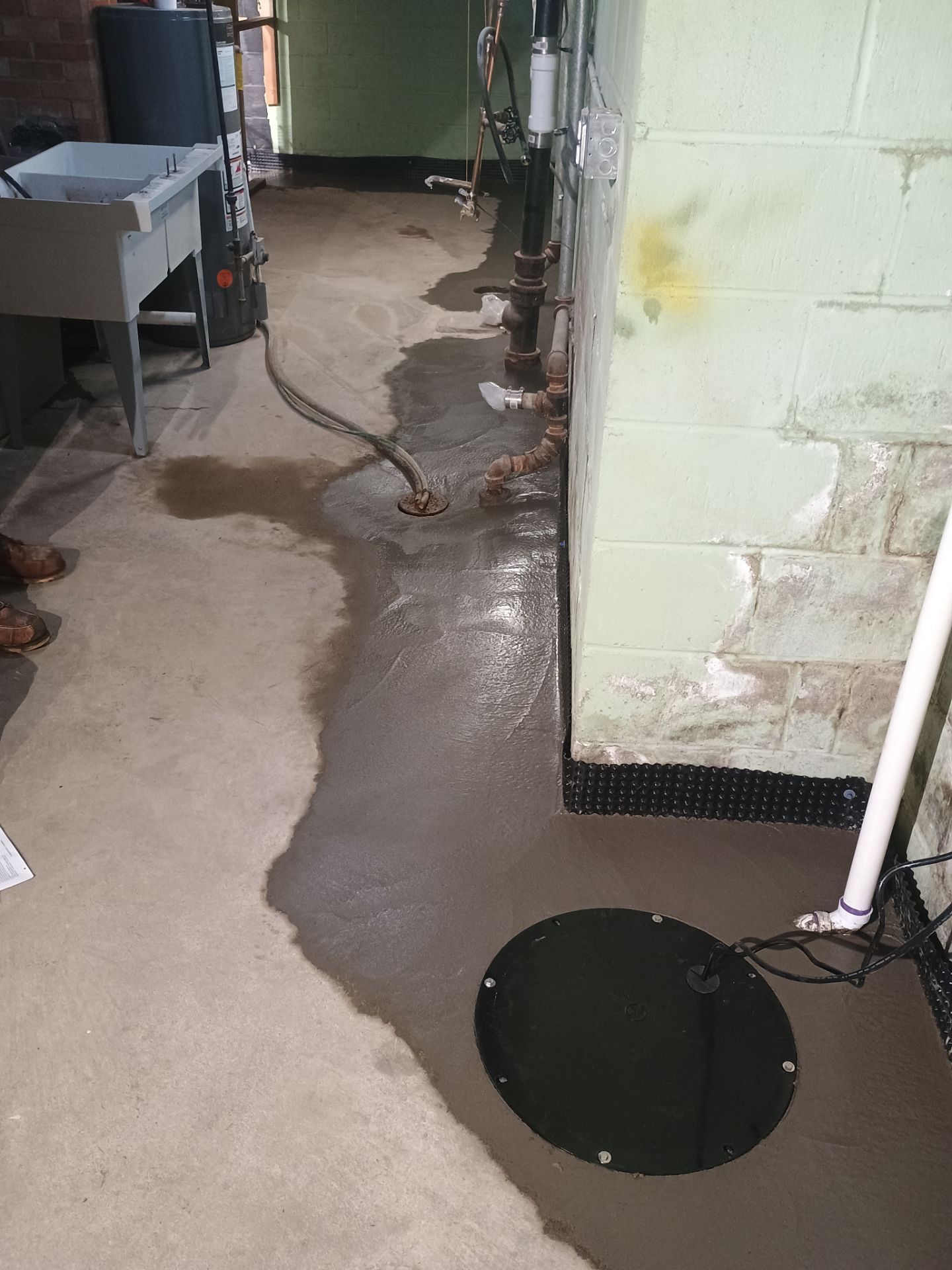
A real interior drain tile system creates a continuous void at the lowest point of the foundation, at footing elevation, below the slab. The slab is cut back 12 to 16 inches from the wall around the specified perimeter. The drainage path is installed at the bottom of the footing without undermining it. A 4-inch perforated corrugated pipe is placed in washed 3/4-inch stone with continuous positive drainage to a sump basin, and the slab is re-poured over it.
The pipe and washed-stone zone create a lower-resistance collection path to the sump. When the system matches the water path and has a reliable outlet, it can lower the local water head in the drained zone and reduce seepage at the floor-wall joint. The result depends on the installed footprint, soil and foundation conditions, sump capacity, discharge, and water arriving outside the treated area.
Two critical details that get cut by lazy installers:
- The pipe is installed at the bottom of the footing without undermining it. It is not a slab-elevation channel; the exact route must follow the written footprint and actual site conditions.
- Washed 3/4-inch drainage stone, not concrete chips or pea gravel. Aggregate selection affects flow paths, sediment behavior, and long-term serviceability.
This comparison explains the methods. Exterior assessments are for 2027 planning. Installation is anticipated in late April or early May, once ground conditions allow. New exterior installations remain closed for the remainder of 2026. Interior drain tile and sump-pump work remain available.
Interior vs exterior, and when each one is the right call.
| Interior drain tile | Exterior drain tile | |
|---|---|---|
| Method | Cut and re-pour slab perimeter; install pipe at the bottom of the footing without undermining it | Excavate 7-10 ft trench around foundation perimeter |
| Timeline | Depends on footprint, access, finishes, and restoration | Depends on depth, access, utilities, structures, and restoration |
| Property impact | Interior slab and finish disruption | Exterior excavation and landscape/structure disruption |
| Cost | Quote from the exact interior scope | Quote from the exact excavation, membrane, drainage, and restoration scope |
| Fit | Determined from interior water path and site constraints | Determined from exterior conditions, access, and repair objective |
Exterior work can address drainage and wall conditions from the outside; interior work can create an accessible collection path to a sump without excavating the entire exterior. They are not interchangeable on every property. WPNE should explain the observed water path, access constraints, proposed footprint, and excluded work before recommending either approach.
What we install and why.
- •4″ perforated corrugated pipe at the bottom of the footing without undermining it, draining positively to the sump
- •Washed 3/4″ stone bedding and cover
- •Vapor barrier wall membrane that routes water into the system, not the room
- •Modern sealed sump basin + an approved American-made Zoeller primary pump, with the exact model listed in the proposal
- •Optional Zoeller Aquanot Spin 508 backup with an approved AGM battery when selected
- •Limited lifetime workmanship coverage for the exact WPNE-installed drain-tile and wall-drainage footprint, subject to the signed agreement
- •Top-of-footer or on-slab plastic channel systems
- •Concrete chips, pea gravel, or whatever was on the truck
- •Plastic-housing box-store pumps or pedestal pumps in primary duty
- •Promises that hydrostatic pressure goes away when it doesn't
- •Vague warranty claims that do not identify the covered WPNE-installed footprint
A WPNE interior drain tile system is installed at the bottom of the footing without undermining it, with:
- 4-inch perforated corrugated pipe installed at the bottom of the footing without undermining it, continuously supported and draining positively toward the sump with no reverse pitch or trapped low spots.
- Washed 3/4″ drainage gravel packed around the pipe. Not chips, not pea gravel, not whatever was on the truck.
- Wall-to-slab vapor management, a polyethylene vapor barrier that ties into the new slab and routes any water that comes through the wall into the system rather than into the room.
- Modern sump basin and an approved American-made Zoeller primary pump. The exact model is listed in the proposal for the job. See our sump pump page for the selection logic.
- Optional Zoeller Aquanot Spin 508 battery backup with a manufacturer-approved AGM battery. Backup is a separate, a la carte choice rather than an automatic inclusion.
WPNE offers a limited lifetime warranty on workmanship for interior and exterior waterproofing services. The warranty transfers to a new homeowner with written notice to WPNE within 30 days of property transfer. Pumps, backups, batteries, alarms, controls, sealants, and other products carry their applicable manufacturer product coverage. The written warranty controls.
Where to start, and where it's worth investigating first.
A full interior drain tile system tends to be the right opening move when:
- Water shows up along the perimeter of the basement floor in multiple spots, classic cove-joint failure
- The home is 50+ years old and has never had a drainage system installed
- The existing drain tile is silted, crushed, or disconnected from the sump (we can scope this)
- You have efflorescence (white crystalline deposits) on the wall and water on the floor, that's active pressure-driven migration
- You've already done the surface-water work and the leak persists
It's worth investigating these issues first, they're obvious contributors that often need attention regardless, and depending on your goals for the space, addressing them can save thousands or extend the time before a full system is necessary:
- Downspouts dumping water within 3 feet of the foundation
- Yard grade that slopes toward the house instead of away from it
- An original sump pump that has never been serviced or replaced
- A leak in a single, isolated spot, often a cracked wall or window-well failure that can be addressed without a full perimeter system
None of these rule out a future system, they're cheaper places to start when they're obvious contributors. We'll walk through what the diagnosis shows and lay out the options, including how each one connects to your long-term plans for the basement.