

The 30-second version.
If you have a quote in hand and you are not sure which system you are being sold, the test is simple. Ask: does the system get installed below the slab, at footing elevation, with new gravel and perforated pipe? If yes, that is drain tile. If the answer involves a plastic channel sitting on top of the footing along the edge of the existing slab, that is WaterGuard (or one of its competitors, BasementGutter, BeaverBaseboard, FlexiSpan, BasementSealers). Both can be the right answer in narrow cases. Most of the time, real drain tile is what your basement actually needs.
What WaterGuard actually is.
WaterGuard is a branded interior baseboard drain product manufactured by Basement Systems Inc. and sold through a network of franchised dealers nationwide. The physical product is a U-shaped plastic channel, roughly three inches wide, that gets installed along the inside perimeter of the basement at slab elevation, on top of the existing footing.
The install sequence: the dealer chips out a strip of slab maybe four inches wide along the wall, exposing the top of the footing. The plastic channel is laid on top of the footing with the open side facing the wall. A new concrete cap covers the slab side of the channel; the open side stays open against the wall. Water that comes through the wall, or runs down the wall from above, drips into the channel and flows by gravity to a sump pit.
The mechanism: WaterGuard catches water after it has already passed through (or down) the foundation wall. It does not stop the wall from getting wet. It does not relieve hydrostatic pressure below the slab. It does not intercept rising groundwater. It is a baseboard gutter at slab elevation.
Pricing varies by dealer and by basement. Read the per-linear-foot rate and the total carefully and compare it against an independent drain-tile quote for the same scope. The franchise warranty is usually marketed as “lifetime,” but read the exclusions section: it typically covers the channel itself, not the wall, not the slab, not the foundation, not seepage from anywhere outside the channel's direct path.
What real interior drain tile actually is.
Interior drain tile is the system the residential building code (IRC R405) and the ASTM specifications for foundation drainage are written around. The physical install: a trench is cut through the existing slab along the inside perimeter, down to footing elevation (typically 8 to 14 inches below the slab depending on the home). Three- or four-inch perforated PVC pipe is laid in a bed of clean drainage aggregate (typically 3/4-inch washed rock) at footing depth, sloped toward a sump pit. The pipe is wrapped or otherwise filtered against fines migration. The trench is backfilled with the same drainage aggregate up to slab elevation, and the slab is patched back in.
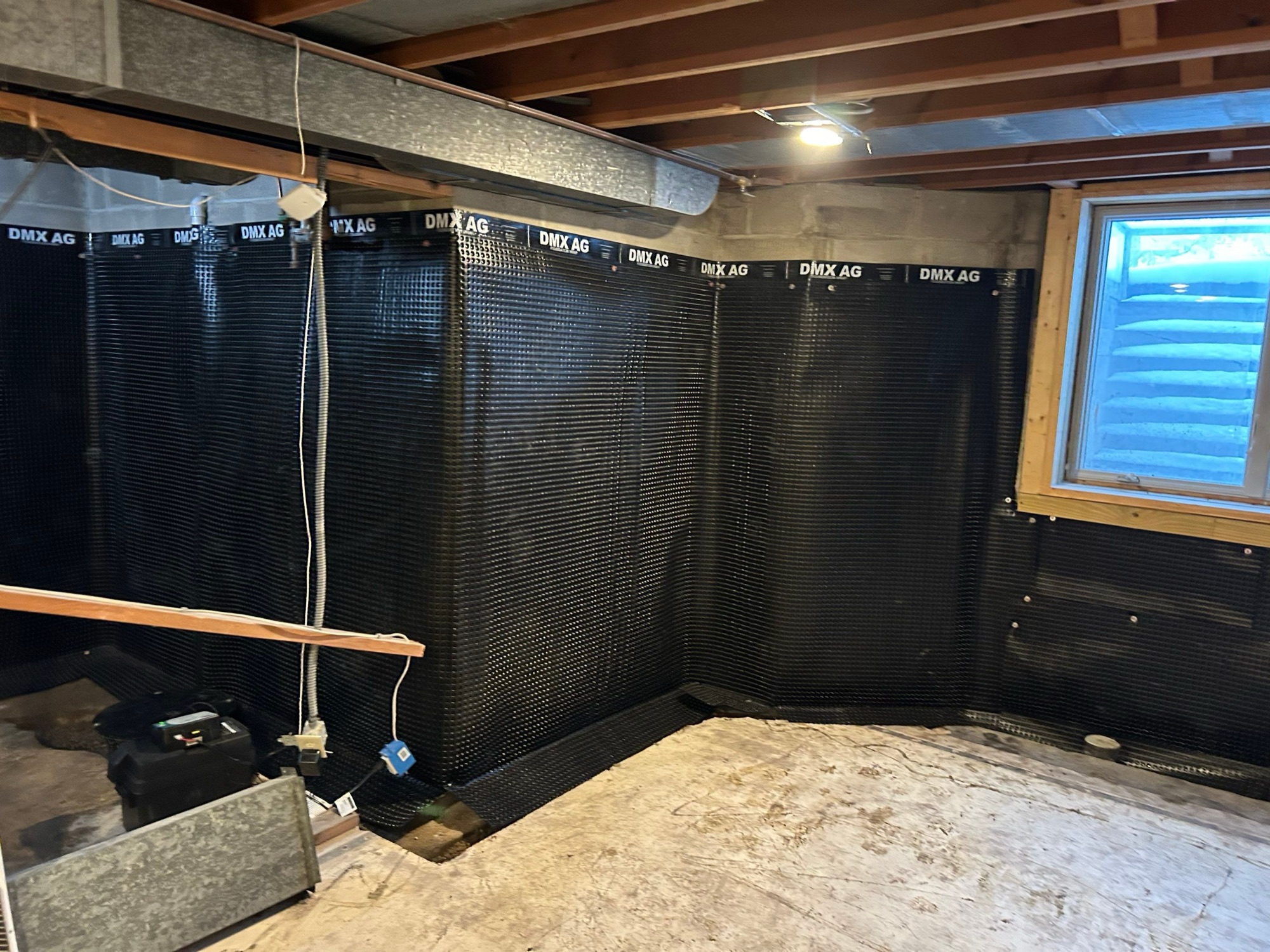
Most modern installs also include a dimple-membrane vapor barrier on the inside face of the foundation wall, tied into the drainage layer at the floor. The membrane does two things: it lets any wall-side moisture drain harmlessly down to the new drain tile instead of evaporating into the basement, and it protects future interior finishes from foundation moisture migration.
The mechanism: real drain tile intercepts groundwater at the source. Rising water table, lateral flow along the footing-slab interface, hydrostatic pressure under the slab, cove-joint seepage at the wall-floor junction, all of these are stopped before they have a chance to enter the basement. The wall does not get loaded with hydrostatic water. The slab does not get pressured from below.
Typical install price in the Twin Cities runs $80 to $150 per linear foot, including a high-quality sump system and tie-in. A standard 150-foot perimeter install lands in the $12,000 to $22,000 range, with depth and access driving most of the variance. The honest-contractor warranty is typically lifetime transferable: if water enters the basement in the area we treated, we come back and fix it free. The warranty moves with the deed.
Side-by-side engineering comparison.
| WaterGuard (baseboard channel) | Real interior drain tile | |
|---|---|---|
| Install depth | On top of footing, at slab elevation | At footing elevation, below the slab |
| What it intercepts | Water that has already passed through or down the wall | Groundwater + hydrostatic pressure BEFORE it reaches the wall |
| Hydrostatic pressure on slab | Unaffected. Slab still gets loaded from below. | Relieved. Drain tile depressurizes the sub-slab water. |
| Hydrostatic pressure on wall | Unaffected. Wall still absorbs water. | Reduced. Less water sits against the foundation. |
| Cove-joint seepage | Caught above the cove (after entry) | Caught below the cove (before entry) |
| Block-wall water entry from below | Not addressed. Water enters block voids below the channel and bypasses it. | Addressed. The footing-depth pipe captures it. |
| Slab cracking from pressure | Continues. Sub-slab water still pressurizes. | Stops. Sub-slab drainage relieves the pressure. |
| Concrete cutting required | Minimal (4-inch strip along wall) | Significant (full perimeter trench through slab) |
| Install time | 1-2 days typical | 2-4 days typical |
| Crew skill required | Lower; modular product, training script | Higher; depth, slope, aggregate, sump geometry all matter |
| Per-linear-foot price | Varies by dealer; ask explicitly | Varies by depth and access; ask for itemized line items |
| Typical full-perimeter install | Often quoted in the same range as honest drain tile | Itemized quote; depth and access drive most of the range |
| Warranty mechanism | Lifetime on the channel only, often with seepage exclusions | Lifetime transferable on the installed system, water in the treated area = free fix |
| Engineering classification | Top-of-footer drain (baseboard gutter) | Sub-slab perimeter drain (per IRC R405 / ASTM F405) |
The single most important fact: WaterGuard never sees the water until the wall has already failed. Real drain tile catches the water before the wall has a chance to fail. That is the entire engineering difference.
When WaterGuard might actually be the right answer.
We don't install WaterGuard. We also don't pretend it has no use case. There are situations where a top-of-footer drain is a reasonable engineering compromise, and homeowners deserve to hear them honestly.
- Very thick or heavily reinforced slabs where cutting through is genuinely impractical without disturbing post-tensioned cables or major reinforcement. Rare in residential.
- Heritage homes with stamped concrete floors the homeowner explicitly does not want disturbed. Aesthetic constraint, not engineering preference.
- Budget-constrained jobs with informed buyerswho understand they are getting a top-of-footer system and are explicitly trading sub-slab depressurization for cost savings. The key word is “informed”, which requires the contractor to spell out exactly what is being installed.
- Poured-concrete foundations with very low hydrostatic pressure and an above-slab cove-joint seepage issue only. Rare in the Twin Cities; common in slab-on-grade construction in drier climates.
If your home is a 1950s Twin Cities block-wall rambler with seasonal hydrostatic pressure, a wet cove joint, and any sign of efflorescence on the walls, WaterGuard is the wrong answer. The water is coming from below the footing through the block voids. A baseboard channel never sees it.
Why franchises sell WaterGuard so hard.
A large franchise network needs systems that can be installed by an interchangeable workforce. Real drain tile is craft work. The depth, the slope, the aggregate selection, the sump basin geometry, the dimple membrane termination, all of these depend on the specific basement. A skilled crew gets it right. A trainee with a checklist may not. The franchise model favors systems where the install is more uniform and less judgment-driven, which is one reason baseboard channel products exist as a commercial category.
WaterGuard, by contrast, is a manufactured product with a fixed install procedure. The franchise dealer trains a crew in a week. The product clips together. The install footprint is small enough that a two-person crew can finish a perimeter in a day or two. The margin per labor-hour is significantly higher than a real drain tile install. That is the actual business reason the system exists.
What this means for homeowners: sales language around these systems can blur the distinction between drain tile and baseboard channel. The phrase “sub-floor drainage” is sometimes used in marketing material, but a top-of-footer channel is not at footing elevation and is not sub-slab in the engineering sense. If the quote does not specify install depth, ask.
- •Ask whether the system installs at footing elevation or at slab elevation
- •Ask whether the install includes new perforated pipe in clean aggregate or a plastic channel only
- •Ask whether the slab gets cut and patched, or whether only a four-inch perimeter strip is removed
- •Get the answers in writing on the quote, with the product name spelled out
- •Get a second quote from an independent (non-franchised) waterproofer for comparison
- •Trust the words “drain tile,” “sub-floor drainage,” or “perimeter drainage” without confirmation of what is actually being installed
- •Assume that a higher price means a better system (it doesn't; franchise WaterGuard often costs the same as honest drain tile)
- •Sign a quote the day of the inspection. Take the quote home, look at it, compare it
Where baseboard-channel installs run into trouble.
When a baseboard channel system underperforms, the engineering pattern is usually one of three things, all rooted in what the system is built to catch and what it is not.
Failure pattern 1, block walls weeping below the channel
On a concrete-block foundation, the wall cavity is hollow. Water that enters the soil outside the footing rises through the block voids by capillary action and lateral pressure. It exits at the lowest available opening, usually the mortar joints just above the footing. WaterGuard sits ABOVE that exit point. The water can weep out below the channel, run across the slab, and end up in the basement anyway. What looks like a waterproofing system is really a partial collection system that does not address the actual entry mechanism.
Failure pattern 2, sub-slab pressure
Without sub-slab drainage, the water table pressure under the floor remains unchanged. In wet years, that pressure can crack the slab. Seepage may come up through the new slab crack while the perimeter channel sits dry. The system can be working as designed and still not be the right tool for a sub-slab hydrostatic load.
Failure pattern 3, the warranty silence
The warranty paperwork on baseboard-channel systems often excludes seepage through the wall, seepage through the slab, seepage at the cove joint outside the channel's direct path, and structural movement. “Lifetime” on the marketing brochure can mean something narrower in the actual contract. Read the warranty document, not just the brochure. Note also: if the original installer leaves the franchise or goes out of business, what happens to the warranty depends on the franchise transfer agreement, which is often opaque to the homeowner.
Baseboard-channel installs do not usually fail because the channel itself broke. They fail because the channel was the wrong tool for what the basement actually needed.
The questions to ask any contractor quoting either system.
- What is the install depth, in inches below the existing slab surface? (Drain tile: 6+ inches typically. WaterGuard: 0 to 2 inches.)
- What pipe spec is being installed, by product name and brand? (Drain tile: ADS or equivalent ASTM F405 perforated PVC. WaterGuard: branded plastic channel, no perforated pipe.)
- What aggregate is being used and how much? (Drain tile: 3/4-inch washed rock, several cubic yards. WaterGuard: minimal or none beyond the channel bed.)
- Will the slab be fully cut along the perimeter and re-poured, or is only a 4-inch edge being removed? (The former is drain tile; the latter is baseboard channel.)
- What is the warranty scope, exactly? Get the warranty document, not just the marketing brochure. Read the exclusions.
- If the wall is a block (CMU) wall, how does the system address water entering through the mortar joints below the footing or below the slab? If the answer is unclear, the answer is probably that the system does not address it.
- Will you describe in writing what system you are installing, and confirm whether it is a sub-slab perimeter drain or a top-of-footer baseboard channel?
A contractor confident in their system will answer these questions plainly. If you can't get clear written answers on questions 4, 5, and 7 in particular, that is itself useful information.
The bottom line.
WaterGuard is a real product with real engineering and legitimate use cases. The honest concern is matching the right system to the right basement. In the Twin Cities, where seasonal hydrostatic pressure, block-wall construction, and high-water-table soils are common, sub-slab drainage often does more engineering work than a top-of-footer channel. That is not a critique of the product; it is a question of fit.
If you have a quote in hand and you are not sure which system it describes, give us a call at (612) 888-6743. We will look at the quote with you, no charge, and tell you plainly whether you are being quoted a sub-slab drain tile system or a top-of-footer channel. If the quote is honest, we will tell you that too.
For a fuller engineering treatment of the alternative-system category, see our companion article on top-of-footer drain systems explained and on the engineering of hydrostatic pressure as the actual force these systems are trying to manage.