

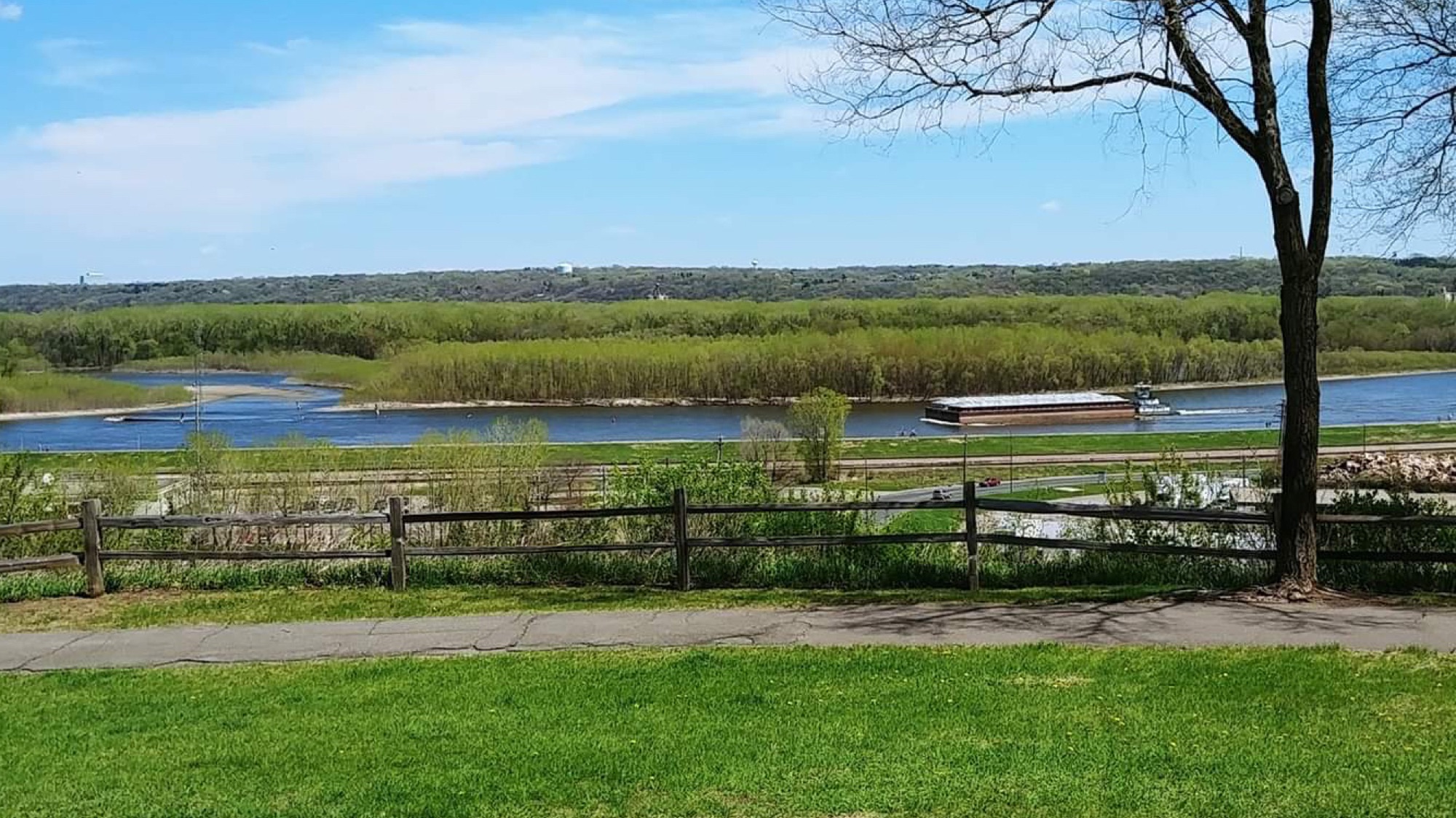
Kaposia and the river bend.
The flats where South St. Paul sits today were known as Kaposia, the seasonal Mdewakanton Dakota village led by Little Crow's lineage through the early 1800s. The Mississippi makes a sharp bend here that creates a natural floodplain, fertile, accessible, and continuously occupied for centuries before any European settlement. Treaties of the 1850s pushed the Dakota out of the area, and the river bend opened to American settlement and, eventually, to industry.
The stockyards arrive.
The South St. Paul Union Stockyards opened in 1886 on the river flats, anchored to the rail lines running between Saint Paul, the wheat country to the west, and the Chicago packing markets to the east. The stockyards were one of the largest livestock markets in the world by the early 1900s. Swift & Company and Armour built massive packing plants directly on the flats; smaller meat-related industries followed. The need for workers was immediate and enormous.
A city for the packing house.
South St. Paul incorporated as a city the year after the stockyards opened, a clear-eyed acknowledgment that whatever this place was going to become, it was going to need its own municipal government to keep up. Workers from across Eastern and Southern Europe arrived through the 1890s and early 1900s. They built modest worker cottages on the bluff above the flats, walked down to the packing houses, and walked back up at the end of shifts. The bluff neighborhoods became densely packed with small one-and-a-half-story homes on small lots, the housing pattern that still defines large parts of the city today.
The industrial peak.
By the 1920s the South St. Paul stockyards rivaled Chicago's Union Stock Yards in livestock volume. Through the Depression and World War II, the packing houses operated continuously. Population peaked at over 25,000 by the 1950s. The post-war years brought a second housing wave, ramblers and small two-stories on the bluff lots that had previously been vacant, plus the first true suburban-style subdivisions on the southern edges of the city.
The slow unwinding.
Consolidation in the meatpacking industry started in the 1960s. Swift closed in 1969. Armour closed in 1979. Smaller operations followed. The stockyards themselves shrank steadily and finally closed entirely in 2008. South St. Paul has been navigating post-industrial redevelopment ever since, new housing on former industrial parcels, a revitalized commercial corridor on Concord Street, and a slow but real demographic recovery. The current housing stock reflects the full hundred-and-forty-year arc: 1890s cottages, 1940s-50s ramblers, 1980s infill, and recent redevelopment on the former packing-house parcels.
The bluff and the flats.
South St. Paul is a two-elevation city. The bluff sits on Platteville Limestone and Decorah Shale with shallow glacial cover above. The river flats below sit on Mississippi alluvium, fine sediments deposited over thousands of years of seasonal flooding, with a water table that can be within a few feet of the surface in spring. The two zones behave so differently that they essentially have nothing in common from a basement-water standpoint.
There's a third condition on the bluff edge itself, properties along the rim experience perched groundwater where the Platteville limestone sits on top of the impermeable shale. Water travels horizontally along that contact and emerges where it intersects a basement wall. This is the same condition that affects West St. Paul and Mendota Heights along the same bluff system.
Why South St. Paul basements leak today.
A South St. Paul leak is usually one of three stories:
- The 1890s–1920s worker cottage near the bluff. Rubble stone or early concrete-block foundation, original lime mortar that has been weeping water for a century. Often no drain tile of any kind. This is foundation work in the most literal sense, the entire perimeter needs an integrated system.
- The 1940s–1950s post-war rambler. Concrete block walls now 70-80 years old with failing mortar joints. Original drain tile silted or collapsed. Sump basin past its second replacement cycle. Interior drain tile system is the typical fix.
- The 1990s-and-newer redevelopment home on former industrial land. Poured concrete on engineered backfill, but the underlying soil conditions can be unpredictable depending on what was remediated. We treat these as their own diagnostic problem rather than assuming they behave like a typical new build.
What this means for your home.
For the oldest cottages and the post-war ramblers, the honest answer is often a full interior drain tile system with a modern sump sized to the actual conditions; a battery backup is optional and quoted separately. We'll quote that directly and state the applicable workmanship coverage for the qualifying installed scope. For the bluff-edge perched-water properties, surface remediation and a properly-sized sump system can sometimes do the job; for the bottomland or former-industrial properties, we'll diagnose carefully before committing to a scope. The river is what it is, the goal is a system that keeps living space dry regardless of what the river is doing.