

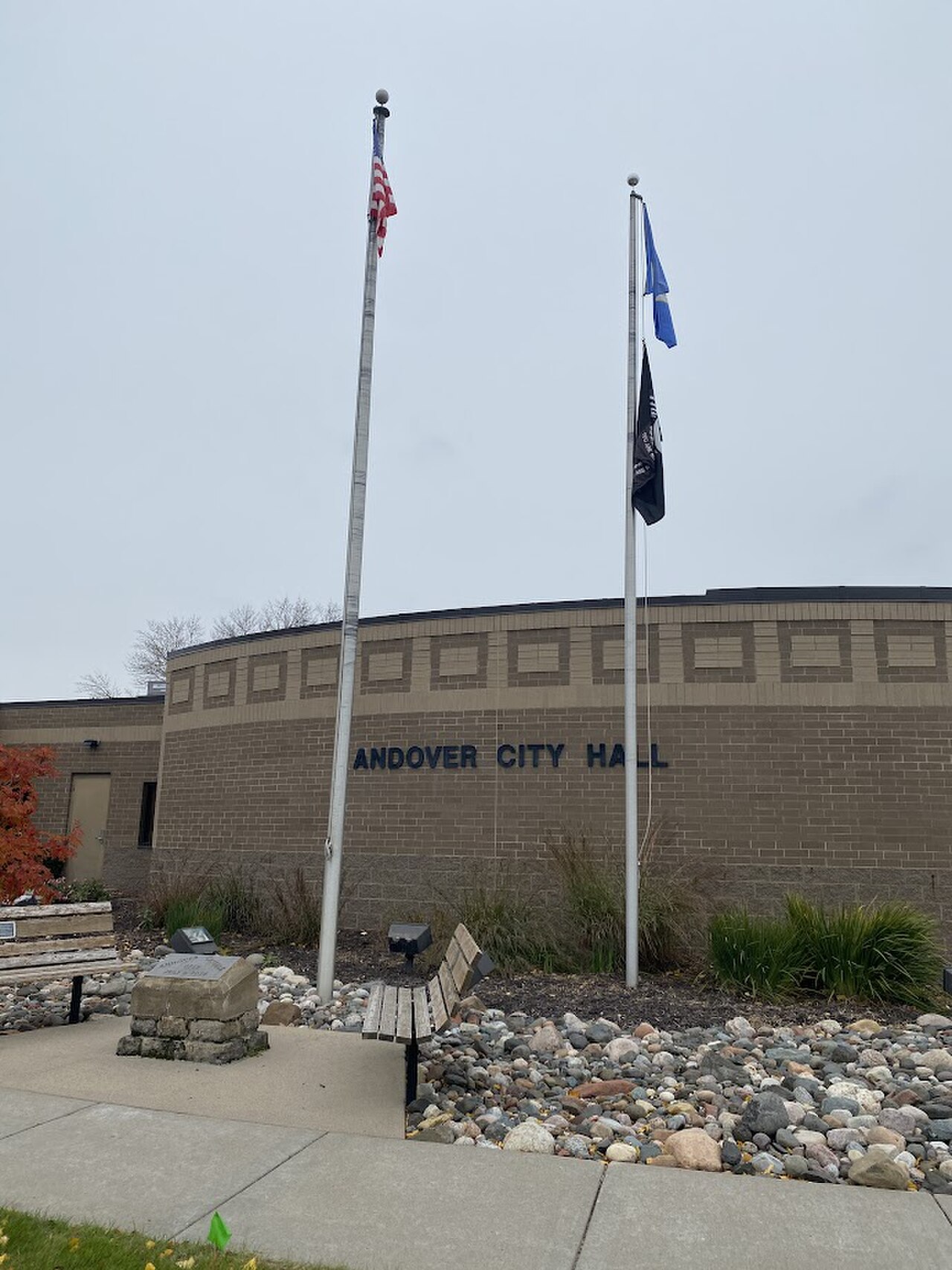
Round Lake Township to Grow Township.
What is now Andover was organized in 1857 as Round Lake Township and renamed Grow Township in 1860 in honor of Representative Galusha A. Grow of Pennsylvania, sponsor of the Homestead Act. For more than a century after that, this was farm country. Sandy upland fields, drained peat lowlands, vegetable crops, sod farms, oak savanna. The area sat outside the orbit of Minneapolis altogether, Anoka County was its own world, and Grow Township was its rural northern edge.
That world changed in 1972, when the Grow Township Board of Supervisors looked at how fast the township was growing and voted to incorporate. Andover Village was established that year. In 1974 it became the City of Andover, a city of the 4th class. Over 95% of the houses you can drive past today were built after that vote. Andover is not, by any honest measure, an old city. But the dirt the city sits on is one of the oldest stories in Minnesota.
The Anoka Sand Plain, 12,000 years older than the city.
Andover sits squarely in the middle of the Anoka Sand Plain, a broad glacial outwash plain that stretches roughly 50 miles along the Mississippi River from the Twin Cities north to St. Cloud. It was deposited about 12,000 years ago by meltwater from the Grantsburg sublobe of the Des Moines Lobe as the Laurentide Ice Sheet retreated. The sediment is dominated by fine to medium quartz sands, 70–90% sand in the upper soil horizons, with very low clay content.
That sandy ground does two things you need to understand if you own a house here. First, it drains very well, too well, in some seasons. Recharge rates into the shallow unconfined aquifer reach 4 to 8 inches per year, far higher than the regional norm. Second, water moves through it fast. When a heavy spring rain or a quick snowmelt hits Andover, the water doesn't sit on the surface and run off the way it does on clay. It infiltrates straight down, hits the water table, and pressurizes the soil column at foundation depth in a matter of hours.
The water table itself is shallower than most homeowners realize. In much of Andover it sits within a few feet of the bottom of a typical basement slab. That margin disappears completely during wet springs.
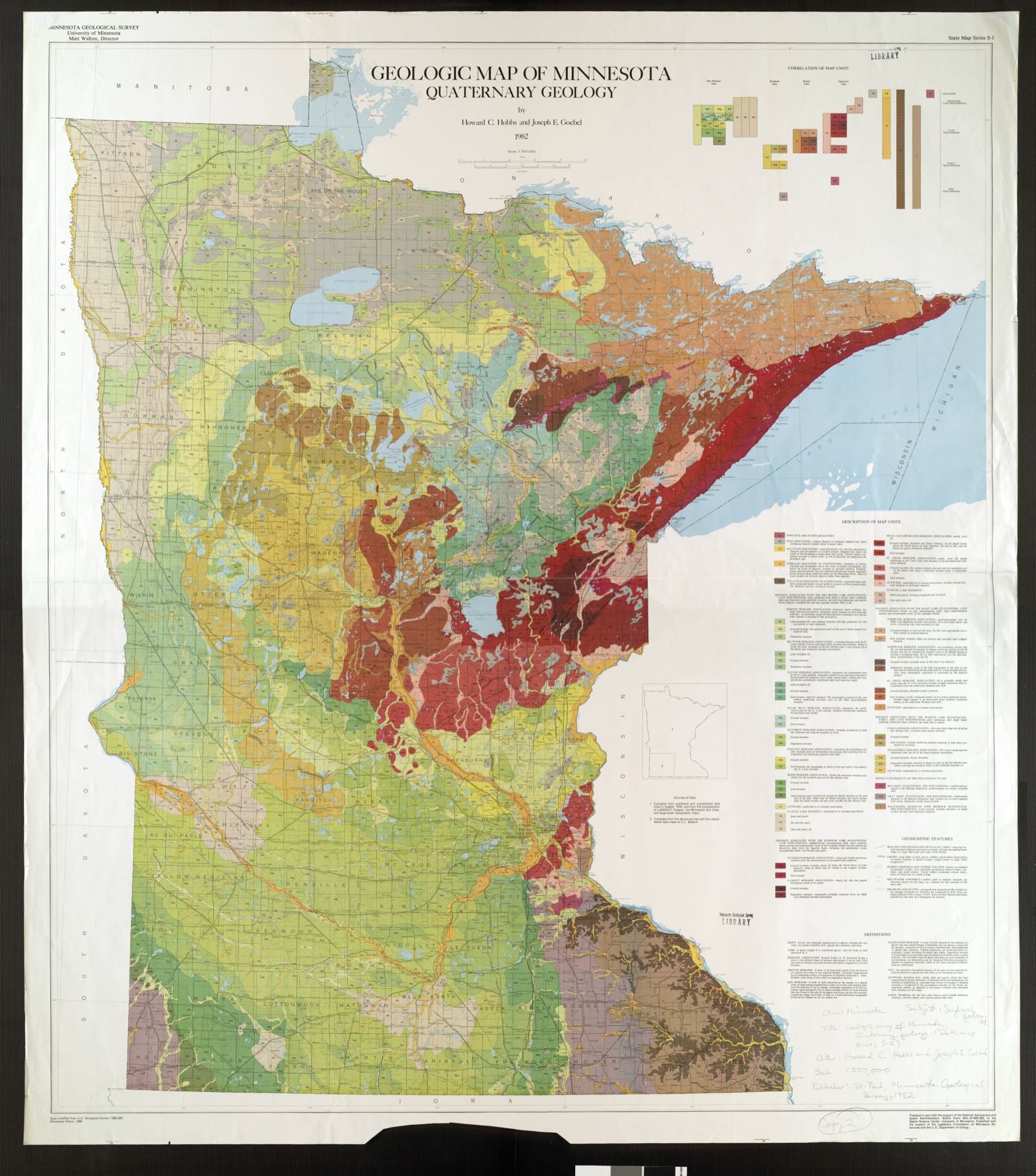
The other Andover: drained peat and muck.
The sand plain isn't uniform. Scattered across it are kettle holes and tunnel valleys, depressions left by buried blocks of glacial ice. After the ice melted, those depressions filled with cold water and, over centuries, with the slow accumulation of organic material. The result is pockets of peat and organic muck, sometimes several feet thick, sitting in low spots throughout the Anoka Sand Plain. One of the largest of these deposits is in eastern Anoka County, the area that includes Andover.
Through the early 20th century, those peat lowlands were drained and farmed. Sod, potatoes, sweet corn, and vegetables thrived on the organic soils once the water was tiled away. By the time the subdivision boom started in the 1970s, those fields looked like good buildable ground, flat, cleared, already accessible. Many of them became Andover's residential streets.
Peat is the worst possible foundation soil. It holds water like a sponge. It compresses unevenly under structural load. It shrinks when dry, expands when wet, and it does all of that on a slow timeline that doesn't show up in the first decade after a home is built. That's a problem we're still meeting for the first time in the field, homes built in the late 1980s and 1990s that have only recently started telling us where the peat pockets were under the original farmland.
Incorporation and the subdivision boom.
When Andover incorporated in 1972, its population was a few thousand people scattered across farmland. By 1980 it had reached 9,387. By the 2020s it was over 31,700. Almost the entire physical city of Andover, homes, schools, streets, drainage infrastructure, was built in that 50-year window. That makes Andover one of the youngest housing stocks of any city our crew services.
The dominant foundation type in Andover is therefore poured concrete, not cinder block. Most homes here were built after CMU block fell out of favor for residential basements. That's a structural advantage, a monolithic poured wall has no mortar joints, which means dramatically fewer entry points for water than the block foundations of South Minneapolis or 1950s Northeast. When an Andover basement leaks, it's rarely because the wall itself is failing.
The advantage of modern construction is also Andover's problem. These homes look bulletproof from the inside. Finished basements, drywall, carpet, fresh paint. Owners assume a home built in 1991 is too new to have water issues. The water doesn't care how new the wall is. It cares what's underneath the slab, and what the grading looks like above it.
Modern homes on complicated ground.
Andover basements are the inverse problem from Minneapolis basements. In Minneapolis, the walls are the weak link, limestone mortar from 1910 or cinder block joints from 1955. In Andover, the walls are fine. The dirt underneath is the weak link.
A typical Andover failure pattern looks like this. A subdivision was platted on former farmland in the 1980s. The developer graded the lots, dug the basements, poured the footings and walls, and backfilled with whatever was on site, often the same sandy soil mixed with patches of organic muck from the kettle depressions. Drain tile was installed at the footing, but it was a single perforated pipe, not a system, and it relied on a sump pump to keep up. Above grade, the lot got a smooth slope away from the house and a layer of sod.
Thirty years later: the original sod has been re-graded by a hundred different homeowners. The downspouts dump within three feet of the foundation. The drain tile has silted up because nobody knew to flush it. The sump pump is on its third replacement. The peat pocket under the southeast corner of the basement slab has compressed an inch and a quarter, opening a hairline crack at the cove joint. The next heavy May rain saturates the sand to within a foot of the slab. Hydrostatic pressure pushes water up through the cove crack onto the basement carpet, and the homeowner calls us because they think their wall is leaking.
The wall is fine. The system around it is the problem.
Why Andover basements leak today.
Most leaking Andover basements share three or four of the same conditions:
- A sand-plain water table that swings hard with the seasons.Andover's shallow unconfined aquifer recharges 4–8 inches a year. Spring snowmelt and heavy May rains push the water table up against the bottom of the slab and stay there for weeks.
- Peat or muck pockets under the original farmland. Where a subdivision was built on filled or drained organic soil, the ground continues to compress for decades. Uneven settlement opens cove cracks and lateral cracks in poured walls.
- Drain tile that has aged out. 1980s and 1990s perforated drain tile is often silted, crushed, or disconnected from the original sump. It cannot relieve hydrostatic pressure when the water table rises.
- Re-graded yards and downspouts that fail at the foundation. Three decades of landscaping projects, deck additions, and gutter changes mean the surface water plan the original builder designed is rarely the surface water plan a house has in 2026.
The remarkable thing is that the same four conditions explain almost every Andover leak we've diagnosed. The diagnosis is the easy part. The discipline is in matching the right repair to the right cause.
What this means for your home.
Most Andover homeowners we meet have been told they need a $15,000 to $25,000 interior drain tile system. In a lot of cases, they don't. The Andover failure pattern is rarely a wall failure, it's usually a drainage system that has fallen out of tune with the surface water that surrounds it. The high-leverage opening move is usually a sump pump replacement, a downspout and grading correction, and a flush of the existing drain tile. Sometimes that combination keeps the basement dry for another twenty years before a full interior system is even on the table.
Sometimes it doesn't. Sometimes the peat pocket under the slab has compressed enough that the original drain tile is below the slab and useless, and a full interior system really is the answer. That's a $15K decision, and we won't make it for you in a thirty-minute sales visit. We'll send a crew member who has actually pulled tile out of Andover lots, looked at what was under it, and can tell you honestly whether your house is in the surface-correction bucket or the real interior system bucket.
Andover's housing stock is some of the newest in the Twin Cities, and it's aging into the part of the curve where the original 1980s and 1990s waterproofing systems are starting to give up. The next ten years are going to be expensive for a lot of homeowners here. We'd rather it not be expensive for the wrong reasons. That's the job.