

Both work. One costs 5× more.
That cost delta isn't about quality of the pipe. It's about what you have to destroy to get the pipe in the ground. On new construction the answer is often exterior. On a home that's been lived in for forty years, the answer is almost always interior.
What each system actually is.
Interior drain tile
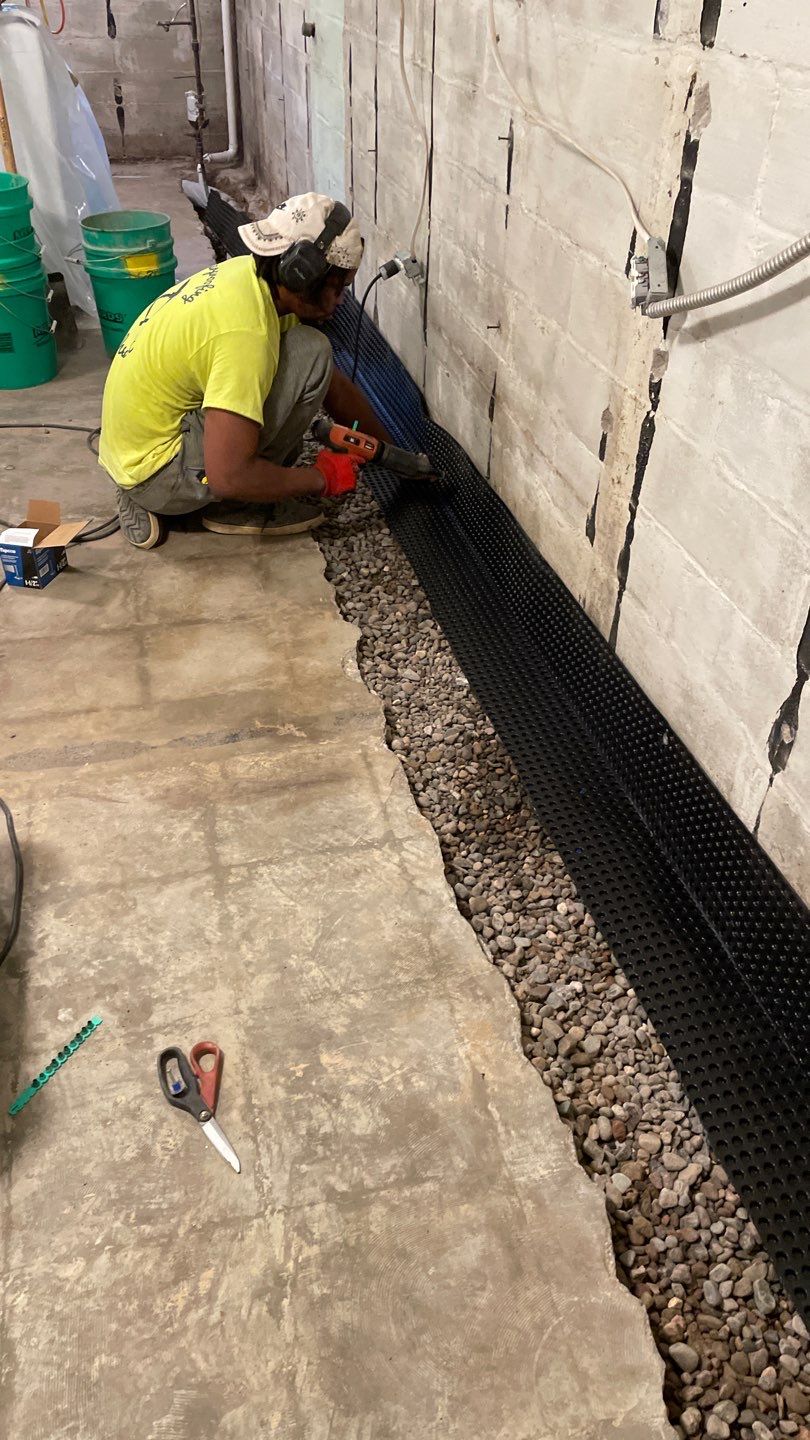
A continuous 4-inch perforated corrugated pipe installed at the bottom of the footing without undermining it, below the basement slab, around the proposal-defined perimeter. The slab is opened along the written footprint, the pipe is placed in washed 3/4-inch stone with continuous positive drainage to the sump, and the slab is re-poured on a full-delivery homeowner scope.
Exterior drain tile
The same 4-inch perforated corrugated pipe, but installed on the outside of the footing, at the same depth. To put it there, the contractor excavates a trench around the foundation to the required elevation. Everything in that excavation zone, landscaping, decks, sidewalks, A/C condensers, and sometimes utility lines, may need to be removed or protected. The wall treatment, drainage layer, backfill, and restoration must be defined by the approved site scope.
Cost comparison and the math.
| Interior drain tile | Exterior drain tile | |
|---|---|---|
| Method | Open slab, install pipe at bottom of footing without undermining, re-pour | Excavate exterior to the designed foundation-drain elevation |
| Timeline | 1-3 days | 1-3 weeks |
| Exterior disruption | None | Decks, gardens, A/C, sod, walkways, all removed |
| Planning cost, scope dependent | $5,000–$25,500+ | $20,000 - $120,000+ |
| Membrane on wall | Optional vapor barrier on inside | Required (rubberized asphalt or bentonite) |
| Best for | Existing homes with active or chronic seepage | New construction, severe bowing walls, exterior wall failure |
Exterior excavation can add substantial access and restoration costs; there is no fixed cost multiple between the two methods. The pipe itself, the gravel, the fabric, those are essentially the same materials. What you pay for on an exterior install is the demolition and restoration of everything between the back of your house and the sky.
When exterior is actually the right call.
There are real situations where exterior is the better engineering answer. They're narrower than franchise sales reps will tell you, but they exist:
- New construction. Before backfill goes in, the marginal cost of installing exterior drain tile and a wall membrane is small. This is what new homes should get and most decent builders include it.
- Severe wall failure or active bowing. If the wall is structurally compromised, bowing inward, cracked horizontally, or shifted, exterior excavation may be necessary to address the structural issue anyway. While the trench is open, install the drain tile.
- Existing exterior membrane that has failed. If a previous owner installed exterior membrane and it's now leaking through (rare in our area, more common with older bentonite installations), patching from outside may be the right call.
- High water tables in granular soils. Some lakefront properties or sand-plain lots have such high seasonal water tables that an interior system can't keep up. Exterior membrane plus exterior drain tile plus an interior backup is the belt-and-suspenders solution.
If a sales rep tells you exterior is “the only real solution” on an existing home with a single leak, walk away.
When interior is the right call.
For most Twin Cities residential basements with a leak problem, the answer is interior. Specifically:
- •Existing home with chronic cove-joint seepage, interior is the textbook fix
- •Finished or semi-finished landscaping you don't want destroyed
- •Budget under $25K, interior is feasible, exterior almost never is
- •Timeline matters, 1-3 days vs 1-3 weeks of construction in your yard
- •Standard glacial-till or sand-plain soil, interior handles both
- •You want a documented long-term system, compare the exact installed footprint, evidence, maintenance duties, and written coverage for each scope
- •New construction (do exterior while the trench is already open)
- •Active structural bowing (foundation specialist first, then waterproofing)
- •Lakefront with year-round high water table (probably both)
- •Commercial buildings with IBC requirements (membrane assembly required)
The honest answer for an existing home.
Almost no one is doing residential exterior drain tile in the Twin Cities anymore, and not because it doesn't work. It works fine. The math just stopped making sense once interior systems matured. A modern interior drain tile with a properly engineered sump and a vapor barrier on the wall gets you 95% of the moisture protection of exterior for 20% of the cost and none of the destruction.
We'll quote exterior when it's the right call. We rarely recommend it for existing homes because we'd be talking customers into spending $40,000 more than they need to. That's not the business we're in.
When you get a quote from any waterproofer, ask them this: what specific condition on my house makes exterior the right answer instead of interior?If they can't name one, a bowing wall, a structural crack, a confirmed exterior membrane failure, they're probably selling you the bigger ticket for the same outcome.