

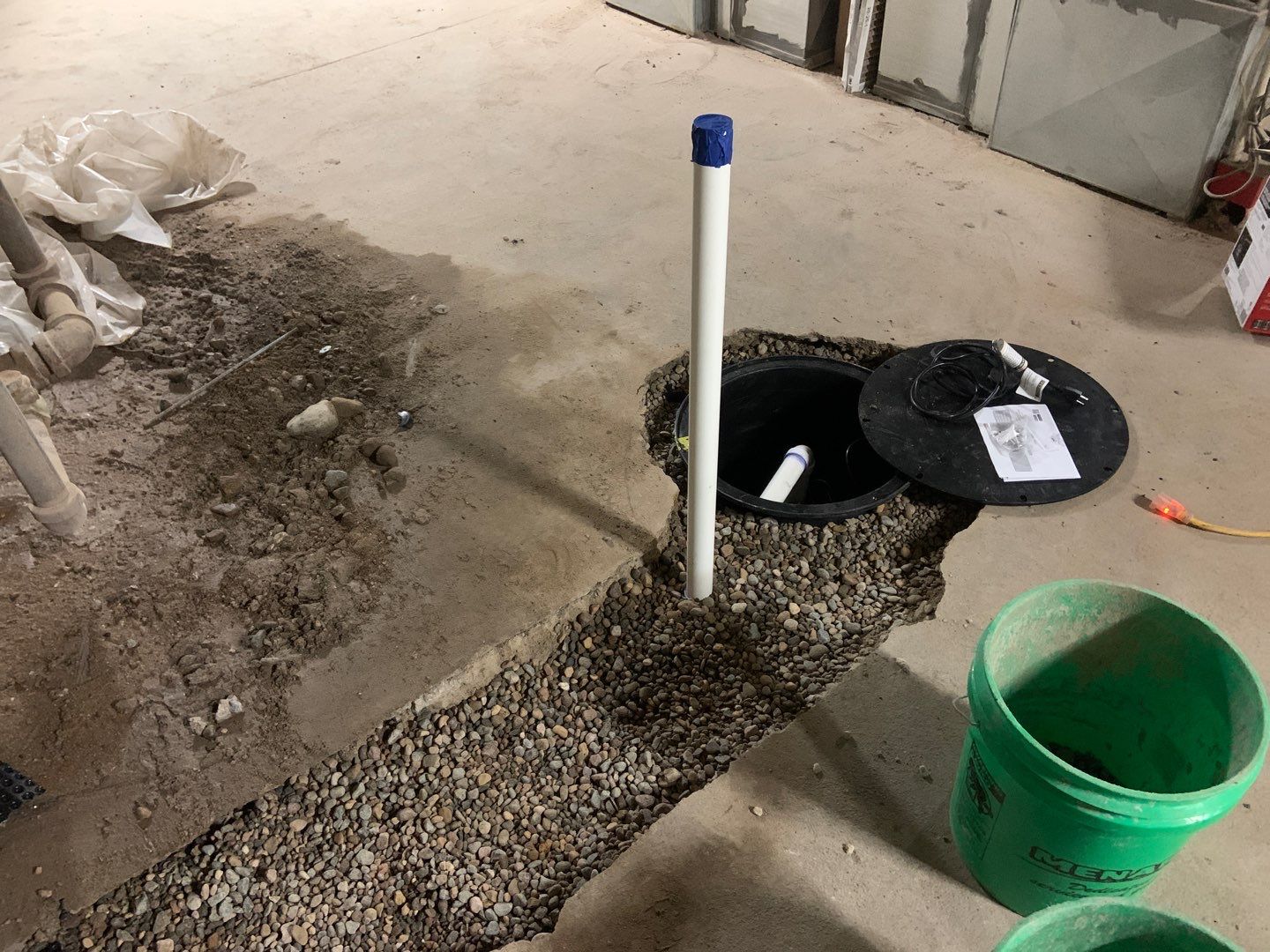
Honest ranges for a Twin Cities basement, 2026.
Those are the ranges we see across our own work and competitor quotes we've been asked to review. The rest of this article explains how they break down, what drives the number up or down, what's included in an honest quote, and how to spot the ones that aren't.
Why one quote is $8,000 and another is $25,000.
Three things usually drive the gap, and they explain most of the variance you'll see between contractor quotes.
1. The scope might not be the same product
A $8,000 quote may be a top-of-footer plastic channel system, the thing some large national franchises sell as “drain tile” that sits at slab elevation, not below the slab. It catches water afterit's breached the cove joint, doesn't relieve hydrostatic pressure, and isn't a real drain tile. A $25,000 quote may be a true interior drain tile installed at the bottom of the footing without undermining it. Same square footage, completely different product. We wrote about the difference at length on the drain tile service page , worth reading before you compare quotes.
2. The pump and backup engineering
A box-store plastic-housing pump with no backup is $200 in materials. An approved American-made Zoeller primary pump, sized to the site and named by exact model in the proposal, is a different product. A Zoeller Aquanot Spin 508 with an approved AGM battery may be selected and priced separately as an optional backup layer. Equipment, capacity, and included options should be compared line by line.
3. Overhead and sales structure
National franchise waterproofers carry massive television, radio, and Google Ads budgets that get priced into every job. They run sales-heavy operations with monthly close-rate quotas, which is why you'll get same-day high-pressure pitches that expire if you don't sign that evening. We're family-owned. Our customers come from Google organic, referrals, and reviews, so our marketing cost per job is a fraction of theirs, and the quote reflects it.
Ask any waterproofer for an itemized written quote. If they won't give one, that's the answer.
Cost by service.
Interior drain tile, $5,000–$25,500+ across measured tiers
The wide range reflects scope. A partial-perimeter install on one wall of an unfinished basement is at the low end. A full perimeter with vapor barrier wall membrane, sealed sump basin, an approved American-made Zoeller primary pump, optional separately selected Spin 508 backup, and a finished-basement protection scope can move the written quote. The starting tier is selected by measured drain-tile length; footing condition, access, basin scope, concrete responsibility, and explicit add-ons are then reviewed.
Sump systems, $500–$800 clean swap or $3,100–$5,200 new system
A straight Zoeller primary-pump swap on a serviceable existing basin, lid, and discharge uses the clean-swap range. A new pit, lid, Zoeller primary pump, and discharge uses the new-system range. The Spin 508 with approved AGM remains a separately selected $1,500–$2,500 option.
Regrading & French drains, choose the base package first
Two-side regrading starts with a $1,500–$5,500 base; 30–60 ft of French drain starts with a $8,000–$9,000 base; the integrated base is $8,000–$14,500. Hand-shaped 2% minimum grade restoration around the foundation, buried PVC downspout extensions to daylight or a pop-up emitter, and laser-leveled French drains with their specified aggregate and geotextile filtration assembly where the site needs them. This is the highest-leverage opening move for many older Twin Cities basements because the obvious contributors at the surface, clogged downspouts, landscaped-away yard grade, splash blocks pointing the wrong direction, drive most of the seepage. Worth investigating first.
Exterior drain tile, $20,000 to $120,000+
Exterior excavation can be appropriate when the assembly must be accessed from outside, especially in new construction or when exterior foundation work is already planned. On an existing home, decks, utilities, landscaping, access, and restoration can make it substantially more disruptive and expensive than an interior system. The right comparison depends on the water path, wall condition, access, and what each quote actually includes.
Commercial waterproofing, quoted per project
Different code, different materials, different documentation. IBC 1805 governs the assembly. Multi-family, retail, office, and industrial jobs are priced by scope after a site walk because the membrane spec, drainage board, duplex pump configuration, and inspection regime vary significantly. See the commercial page for the engineering side.
What drives the number up or down.
| Pushes cost UP | Pulls cost DOWN | |
|---|---|---|
| Linear footage | Full perimeter (all 4 walls) | Partial perimeter (1-2 walls) |
| Basement state | Finished, drywall, framing, flooring to remove | Unfinished, clean concrete perimeter |
| Soil & geology | High water table, Anoka Sand Plain, lake-adjacent | Standard glacial till, good natural drainage |
| Existing infrastructure | No sump pit, no discharge line, electrical needed | Existing pit in good shape, discharge route clean |
| Wall material | Block wall needing vapor barrier + parging | Poured concrete in good condition |
| Access | Stairs only, no walkout, distance to truck | Walk-out access, level haul to truck |
What's in a WPNE quote, line by line.
Every quote we hand over breaks out the components so you can compare ours to anyone else's. Here's what a typical interior drain tile line-item looks like:
- •Linear feet of 4-inch perforated corrugated pipe installed at the bottom of the footing without undermining it
- •Concrete demo & re-pour with a washed 3/4-inch stone bed for full-delivery homeowner scopes; contractor/GC handoff exclusions must be explicit in writing
- •Sealed sump basin (new install or existing pit rebuild)
- •American-made Zoeller primary pump, with the approved brand and exact model named in the proposal
- •Optional Zoeller Aquanot Spin 508 with an approved AGM battery, selected and priced separately
- •Discharge plumbing with check valve, pitched to drain outside the freeze line
- •Vapor barrier wall membrane (when scoped)
- •Permit fees (when required)
- •Written warranty terms identifying the exact covered work and any future-owner transfer process
- •Bundled mystery pricing without component-level breakdown
- •Add-ons that show up after the contract is signed
- •“Proprietary” pumps with no published spec sheet
- •Restoration of finished surfaces (drywall, flooring), usually coordinated separately
- •Landscaping or grading restoration after exterior work
If a competitor won't give you a line-item breakdown, ask why. Itemizing is the basic test of whether a quote is honest. We'll walk you through ours on the spot.
Financing, insurance, taxes.
After you have a written WPNE proposal, its Acorn Finance option can show prequalified offers from multiple lenders. Checking uses a soft credit check with no score impact; a hard inquiry may occur if you choose and proceed with a lender. The lender funds you directly, then you pay WPNE according to the signed proposal. WPNE does not set or promise approval, rates, terms, or a monthly payment. Full financing details are on the financing page.
Homeowner's insurance usually does not cover groundwater seepage or hydrostatic pressure failures. Sudden accidental losses with a sewer-backup rider sometimes are. Preventive waterproofing is on the homeowner. The flip side: doing the work prevents losses your insurance would also exclude.
Taxes: for a primary residence, basement waterproofing is a capital improvement, not a repair, not deductible in the year you do it, but adds to your cost basis and reduces capital gains tax when you sell. For rental properties, treatment varies; talk to your accountant. We provide itemized invoices with any documentation your CPA needs.
Resale documentation: A signed proposal, paid invoice, job photos, and written warranty terms can help a future buyer understand what work was completed and what is covered. They do not guarantee an appraisal increase, a particular sale outcome, or that the project will pay for itself.
Five questions to ask every waterproofer.
- Is the drain tile installed at the bottom of the footing without undermining it, or at slab elevation? Below-slab is real drain tile. Slab-elevation channels are gutters in a different package.
- What brand and model is the primary pump, and is the housing cast iron or plastic? “Our exclusive proprietary pump” is usually a white-labeled box-store pump with a sticker.
- What exact installed footprint does the written warranty cover, and what is the future-owner transfer process? Coverage and transfer rules should be written into the agreement; do not rely on a verbal description or a generic headline.
- Are you bonded and insured, and can I see a Certificate of Insurance? Minnesota residential contractors are licensed through the Department of Labor and Industry, you can verify any license number at dli.mn.gov. Ours is MN IR802718.
- Will you give me an itemized written quote before I sign anything? This is the one that separates the family-owned crews from the high-pressure sales operations. Anyone hedging on this is hiding something.
If you're comparing our quote against another waterproofer in the Twin Cities, walk through the five questions on each one. The honest ones will answer them the same way we do. The ones that hedge are telling you everything you need to know.