

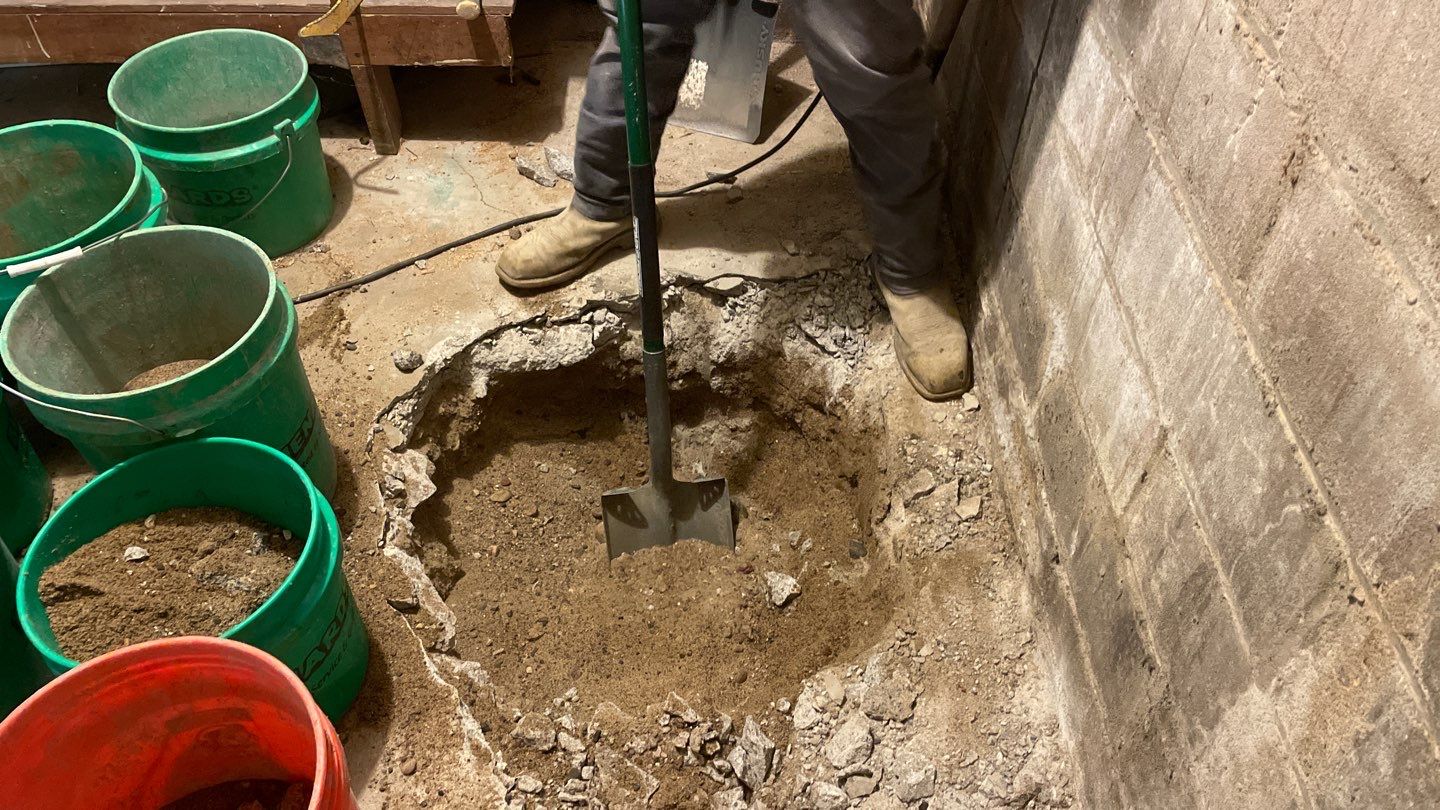
The Anoka Sand Plain is a 12,000-year-old gift.
When the Wisconsin glacier retreated about 12,000 years ago, the Grantsburg sublobe of the Des Moines Lobe dumped massive volumes of meltwater across what is now the north metro. That meltwater sorted the sediment by grain size as it flowed, heavier particles dropped out first, finer ones traveled further, leaving a thick deposit of well-sorted, granular sand across an enormous area. That deposit is the Anoka Sand Plain.
From a basement-waterproofing perspective, this is good news and bad news. Good news: the sand drains beautifully. Surface water moves through it like a colander. Bad news: it also transmits water to foundation depth within hours of a heavy rain, and the seasonal water table swings much more dramatically than in surrounding glacial till.
Why sand-plain basements leak differently than till basements.
| Sand plain (Anoka, Blaine, Fridley) | Glacial till (most of Hennepin, Ramsey) | |
|---|---|---|
| Soil composition | 70-90% quartz sand, very low clay | Unsorted clay, silt, sand, gravel mix |
| Drainage rate | Fast, hours after rain | Slow, days after rain |
| Failure mode | Water table itself rises into footing zone | Clay-bowl trap pressurizes wall |
| Seasonal water table | Swings 4-8 inches with snowmelt | Swings 1-3 inches |
| Best fix | Below-slab drain tile + larger sump capacity | Below-slab drain tile + grading work |
| Surface water role | Lower, water drains away fast | Higher, water pools and pressurizes |
The practical implication: a Hennepin County basement leaks because surface water gets trapped in the backfill ring and pressurizes the wall. Fix the gutters, fix the grade, and the leak often goes away. A Blaine basement leaks because the actual water table rose into the slab. No amount of grading work will help, you need to manage the groundwater itself, which means drain tile and properly sized pumping.
The seasonal water table swing, 4 to 8 inches.
USGS monitoring wells across the Anoka Sand Plain show that the local water table rises 4 to 8 inches between mid-March and late April most years, then falls back over the summer. In wet springs it can rise more than a foot.
For a basement that's sitting with its floor 12 inches above the winter water table, a 6-inch rise is the difference between “dry all year” and “water on the floor every April.” The water table didn't become a problem, it crossed your foundation elevation.
On the Anoka Sand Plain, you don't have a waterproofing problem. You have a groundwater management problem. Different problem, different solution.
This is why sand-plain basements may need larger pump capacitythan typical glacial-till installs. WPNE sizes the primary pump from observed flow, basin, lift, discharge route, cycling, and the manufacturer's pump curve. The approved American-made brand and exact model are named in the proposal.
What actually works on sand plain.
- Below-slab interior drain tile, same product as anywhere else, but the system has to handle higher peak flow rates during the spring rise.
- Properly sized primary pump, using observed flow and site conditions rather than a neighborhood-wide default; the approved American-made brand and exact model appear in the proposal.
- Discuss backup as an optional risk-control layer, because high inflow and utility outages can occur together. WPNE offers the Zoeller Aquanot Spin 508 with an approved AGM battery as a separately selected option; the site findings and signed proposal control.
- Discharge management matters more, sand drains everywhere, including back to your own foundation if the discharge isn't run far enough away. We pipe discharge 15+ feet from the foundation on sand-plain installs.
- Grading work still helps, even though sand drains fast, surface water management reduces the load on the drainage system.
Which Twin Cities towns sit on the Anoka Sand Plain.
The Anoka Sand Plain covers most or part of these cities in our service area:
- Andover, almost entirely on sand plain
- Blaine, almost entirely on sand plain
- Coon Rapids, most of the city, especially east and north
- Fridley, eastern half particularly
- Northeast Minneapolis, the Audubon and Holland neighborhoods
- Shoreview, partial, west side
- White Bear Lake, small portions
If your house is in any of these neighborhoods and you're fighting a wet basement, the diagnosis usually starts with the water table, not the gutters. Doesn't mean the gutters don't matter, they always do, but the dominant mechanism is groundwater, not surface flow. Get the right diagnosis first, then fix the right thing.